Yesterday I didn’t even plan to go further with this discussion, but today’s reply from
produco — which avoided the points I raised and focused instead on my usage history — made it clear that additional context is needed.
I’m going to show an example of another repair forum that operates differently. It’s free to join, has a simple entry test to filter out beginners, and requires around 15 posts before file downloads are allowed. Files are exchanged for credit, and credit is earned by contributing advice or sharing resources such as boardviews, schematics, and BIOS files.
This model keeps the community active, maintains quality, and preserves free access to repair documentation. It also results in a larger and more up‑to‑date library than Badcaps, without requiring a subscription.
I’m sharing this because it demonstrates that sustainable, contribution‑based models exist, and they address the concerns I raised earlier about paywalling repair resources.
First of all, Badcaps's Schematics and Boardviews section --
https://www.badcaps.net/forum/document-software-archive/schematics-and-boardviews
Secondly, Badcaps's Troubleshooting Laptops, Tablets, and Mobile Devices section --
https://www.badcaps.net/forum/troubleshooting-hardware-devices-and-electronics-theory/troubleshooting-laptops-tablets-and-mobile-devices
As the screenshots show, both the Schematics/Boardviews section and the Troubleshooting section have a large number of unanswered requests — whether for boardviews, schematics, or repair advice. This aligns with what I mentioned earlier: the response rate and depth of technical guidance on Badcaps has been inconsistent for years, especially compared to other repair communities.
Furthermore, on Badcaps, typical Boardview & Schematics
answered post looks like this. 1 file, and 5 replies saying "Thanks". Thus absolutely everything in Badcaps numbers is inflated — because we are counting "Thanks" which are completely irrelevant. On forum I'm going to show you bellow it is illegal to write off-topic messages, you can say thanks by pressing the "thanks button" if you wish.
 Now I want to show an example of another repair forum for comparison.
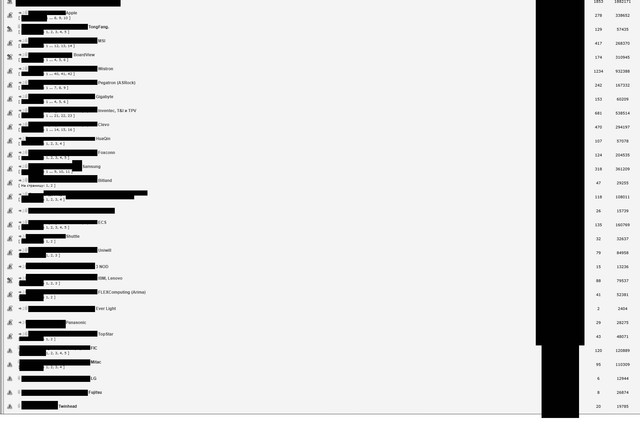
 I’ve redacted topic names and changed colors so it can’t be found through search engines — this is only to illustrate the structural differences, not to harm Badcaps. The model used there is simple: free access, a basic entry test to filter out beginners, and a requirement of around 15 posts before file downloads are allowed. Replies are consistent, and unanswered threads are rare.
The first number in each screenshot is the reply count. Notice that none of them are zero. On Badcaps, zero‑reply threads are common, both in the schematics section and in the troubleshooting section. This aligns with what I mentioned earlier about response consistency and advice quality.
 This is the notebook repair section for ASUS platforms. It’s just one category — the forum has separate sections for ASUS, Dell, Samsung, Rover, Apple, HP/Compaq, Toshiba, Sony, LG, BenQ, Fujitsu‑Siemens, Lenovo/IBM, Acer/eMachines, Packard Bell/NEC, MSI, Xiaomi, Huawei, Honor, Clevo, Gateway, and others. Not to mention sections for PC motherboards, video cards, TVs, SSD's, data recovery, cell phones, tablets, power supplies, printers, and others. Across all of these sections, reply counts are consistently above zero. Unanswered threads are extremely rare.
Now, looking at the Boardview & Schematics section: this forum has 2,270 topics and 20,525 messages. Each message corresponds to a file, because the structure is “one platform per topic.” As shown in the screenshots, none of these topics have zero replies.
By comparison, Badcaps has 3,429 topics and 4,729 messages in its Schematics/Boardviews section. Badcaps uses a “one model per topic” structure, so each topic may contain multiple files — but even accounting for that, the total number of files is still far below 20,525.
The first number in each screenshot is the reply count, and the second is the view count. The difference in activity and resource volume between the two models is clear.
It’s also worth noting that this discussion isn’t happening in isolation. Across multiple repair forums and technical communities, there have been recurring threads expressing dissatisfaction with Badcaps’ direction, especially after the introduction of the paywall. The concerns raised here — declining activity, unanswered troubleshooting requests, and reduced availability of repair documentation — are echoed by many users on other boards. This isn’t a single‑user perspective; it’s part of a broader trend that has been visible for some time.
We’ve already seen how similar decisions played out elsewhere.
https://hardw.net/ implemented a comparable monetization model and eventually collapsed as participation dropped and uploads slowed. The pattern is consistent: when a community built on shared contributions moves to a subscription‑based access model, engagement declines and the resource base stagnates.

 Home
Home Help
Help Search
 Login
Login Register


